
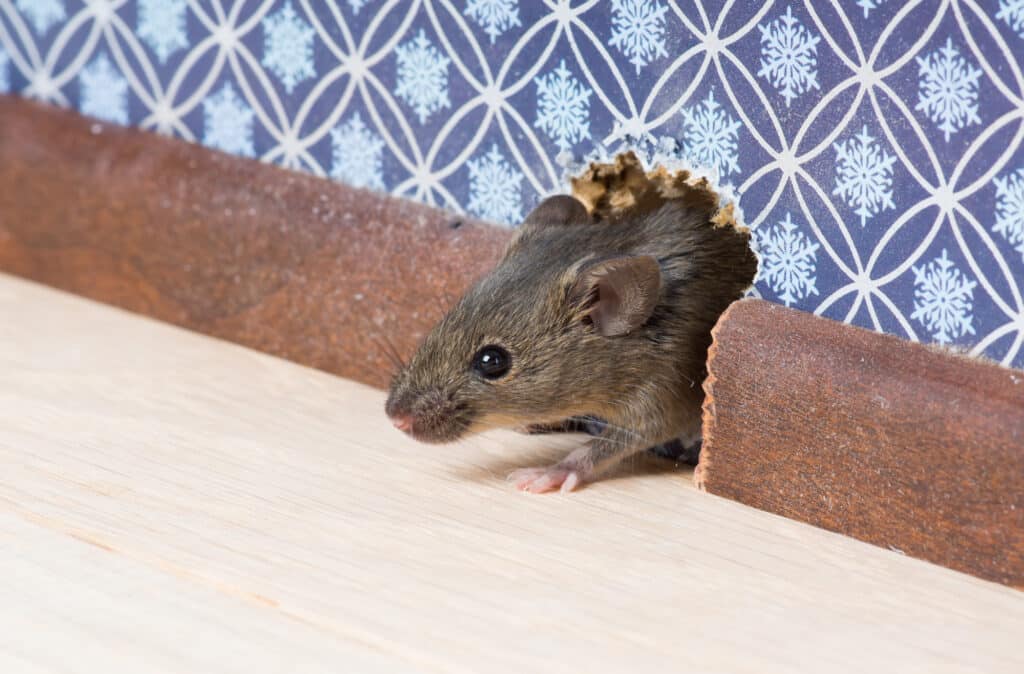
It starts with a sound. A faint scratching behind the drywall at 2 in the morning. Then a faint gnawing. Then silence. You check the kitchen the next morning and find small, dark pellets near the baseboards, but no mouse in sight. You check again the next night. More sounds. You tell yourself it might be the pipes settling or the house contracting in the cold, but somewhere in the back of your mind, you already know what it is.
Mice in walls represent one of the most frustrating and underestimated home infestations a homeowner can face. Unlike a mouse scurrying across your kitchen floor, mice in wall voids and crawl spaces operate in a completely hidden environment. They breed, nest, feed, and destroy structural components behind surfaces you cannot see and in spaces you rarely access. By the time visible signs appear in your living spaces, the colony inside your walls may already number in the dozens.
This guide is built for homeowners who want real answers: not surface-level tips, but a thorough understanding of how mice control actually works when rodents have taken up residence inside the structure of your home. We will cover everything from signs of mice in walls and how they get inside, to what exterminators do to get rid of mice in walls actually looks like in practice, and what long-term mice control requires to be permanent. At iPest Control Inc., we have handled thousands of rodent cases in South Florida, and we know that vague advice does not solve real infestations. This guide will not give you vague advice.
Why Mice Target Walls and Crawl Spaces
To understand how to get rid of mice effectively, you first need to understand why they are inside your walls in the first place. It is not random, and it is not accidental. Mice choose wall voids and crawl spaces because these environments check every single box on a rodent’s survival checklist.
The Perfect Habitat
Wall cavities offer darkness, warmth, protection from predators, and proximity to food. House mice, the species most commonly responsible for mice in wall situations, nest within an average of 30 feet of their food source. This means a mouse nesting inside your kitchen or bathroom wall has direct access to crumbs, food packaging, and water from leaking pipes without ever needing to expose itself in the open. Your walls are not just a hiding spot; they are a complete, self-contained living environment for a rodent.
Mice in crawl space situations develop for similar reasons. Crawl spaces are dark, rarely disturbed by humans, and often warmer than the surrounding soil. They typically contain abundant nesting material in the form of exposed insulation and wood framing. Moisture in a crawl space, whether from groundwater intrusion, condensation, or plumbing leaks, provides the water source a mouse colony needs to thrive indefinitely.
How Fast They Multiply
The urgency of addressing rodents in walls cannot be overstated. A house mouse reaches sexual maturity in roughly six weeks. A single female can produce 5 to 10 litters per year, with 5 to 6 pups per litter. Under favorable conditions inside a wall void or crawl space, with warmth, shelter, and proximity to food, Orkin has documented that mouse populations can exceed 200 specimens in a matter of months from a single pair of founders. This is not a problem that resolves itself.
Mice are also fundamentally nocturnal. Their peak activity occurs just after dusk and just before dawn. This is precisely why homeowners often describe hearing scratching in walls but no droppings in visible areas: the mice are active at night inside the wall, but have not yet pushed into living spaces during daylight. By the time droppings appear in your kitchen, the colony has almost certainly been established in your walls for weeks or months.
House Mouse vs. Field Mouse: Why Identification Matters for Treatment
Not all mice are the same, and treating the wrong species with the wrong strategy is one of the most common reasons getting rid of mice in house efforts fails. The two species most frequently encountered by homeowners are the house mouse (Mus musculus) and the field mouse, most commonly the deer mouse (Peromyscus maniculatus). Understanding the house mouse vs field mouse distinction is critical, particularly because they carry different diseases, behave differently indoors, and require different control approaches.
| Feature | House Mouse (Mus musculus) | Field Mouse / Deer Mouse (Peromyscus maniculatus) |
| Body color | Solid gray to light brown | Two-toned: brown back, white underside |
| Tail | Long, thin, uniform color | Bicolored: dark on top, white underneath |
| Ears | Large, pointy, turn outward | Larger, rounded, face slightly forward |
| Size | 5-7 inches including tail | 7-10 inches including tail |
| Indoor nesting | Year-round; breeds continuously indoors | Seasonal (fall-winter); prefers outdoors |
| Nest location | Wall voids, near appliances, stored goods | Bulky nests from grass/leaves; hoards seeds |
| Primary disease risk | Salmonellosis, leptospirosis (via food/surface contamination) | Hantavirus Pulmonary Syndrome (38% fatality rate) |
| Cleanup protocol | Standard PPE; wipe with disinfectant | Strict CDC protocol; wet disinfectant only, no dry sweeping |
| Reproduction rate | Up to 10 litters/year indoors; never stops | Moderate; environmentally limited outdoors |
| Urban/suburban frequency | Extremely common | Rural, wooded, or farm-adjacent properties |
The Disease Risk Difference
This table is not academic. The field mouse, particularly the deer mouse, is the primary reservoir of Sin Nombre hantavirus in North America. The CDC has documented a case fatality rate of approximately 38% for Hantavirus Pulmonary Syndrome, the respiratory illness it causes. The virus is shed in deer mouse urine, feces, and saliva, and is transmitted to humans primarily through inhalation of airborne particles when disturbed nesting material is swept or vacuumed dry.
If you suspect how to get rid of field mice is your situation, specifically if your property borders wooded areas, fields, or farms, you must approach cleanup with extreme caution. Never sweep or vacuum dry droppings from a field mouse infestation. Soak all contaminated material with a bleach-water solution (1.5 cups bleach per gallon of water) before handling, wear N95 respirators and disposable gloves, and double-bag all waste before disposal. For how to get rid of field mice permanently, the approach also includes stronger emphasis on exterior habitat modification since these mice primarily live outdoors and enter homes seasonally.
Can Mice Climb Walls? Understanding Mouse Mobility
Can mice climb walls? This is one of the most searched questions about rodents, and the answer is emphatically yes. Understanding mouse mobility is essential for understanding how they access wall voids and travel inside your home.
Climbing Ability
Can mice crawl up walls? Absolutely. House mice are exceptional climbers capable of scaling virtually any rough vertical surface: brick, concrete block, stucco, wood siding, and the interior framing lumber inside your walls. Their claws are designed for gripping textured surfaces, and their light body weight (a house mouse weighs roughly 0.5 to 1 ounce) means minimal grip is required to support them. The one surface type they struggle with is smooth, clean metal or glass, which offers no purchase for their claws.
Can mice climb up walls made of smooth drywall? With difficulty alone, but with friction points (baseboards, outlets, gaps), yes. Inside a wall cavity, however, there is no such limitation. Wood studs provide an ideal climbing surface, and mice travel vertically through wall interiors as easily as they move horizontally, which is how a mouse that entered through a basement foundation crack can appear in an attic space with no other obvious pathway.
Additional Mobility Facts
- Jumping: House mice can jump up to 12 inches vertically from a standing position, allowing them to reach countertops, shelves, and entry points that homeowners assume are inaccessible
- Vertical wall climbing: Mice can run straight up the inside of a wall cavity, using the framing as a ladder to access any floor of a multi-story home from a single ground-level entry point
- Pipe and utility lines: Mice use plumbing pipes, electrical conduits, and HVAC ductwork as internal highways, traveling along them inside walls and between floors
- Rope and cable: Mice can traverse overhead cables and utility lines, which is why tree branches touching your roofline create a direct access route into your attic and upper-wall spaces
- Swimming: In rare cases, mice can travel through floor drains and sewer lines, particularly in older urban plumbing systems with degraded seals around sewer connections
Signs of Mice in Walls and Crawl Spaces
Accurate identification of signs of mice in walls is the first step in any effective mice control strategy. The challenge is that wall-nesting mice are designed by evolution to avoid detection. Most of the following signs require active observation and, in some cases, knowing exactly when and where to look.
Sound Signatures: What Do Mice Sound Like in Walls?
What do mice sound like in walls? This is highly specific and helps distinguish mouse activity from other structural sounds:
- Scratching and scurrying: The most common sound. Short bursts of rapid scratching or scurrying, typically lasting a few seconds, then stopping. It occurs most frequently at dusk and just before dawn when mice are most active. This is distinct from the slower, more deliberate scratching of a larger animal like a squirrel or rat
- Gnawing: A repetitive, rhythmic chewing sound. Mice gnaw on wood framing, drywall, and electrical wire insulation. This sound is more sustained than scurrying and tends to occur in one fixed location
- Squeaking: High-pitched vocalizations, more common when mice are communicating within a nest or when young pups are present. This sound typically indicates an established colony rather than a solitary mouse
- Thumping and bumping: Occasional light thuds, particularly in wall spaces, as mice move quickly or fall while climbing inside the cavity
Critical timing note: these sounds are almost always nocturnal. If the sounds stop completely once you get up and move around, that is consistent with mouse behavior. Mice are highly sensitive to vibration and human movement and will freeze when they detect it.
Visual and Physical Signs
- Droppings: Mouse droppings are 3 to 6 mm long, dark brown to black, tapered at one or both ends, and resemble grains of rice. Fresh droppings are moist and dark; older droppings are dry and gray. Finding droppings along baseboards, in cabinet corners, behind appliances, or near food storage confirms active mouse presence. Scratching in walls but no droppings in living areas indicates mice that are currently confined to wall voids and have not yet penetrated into the living space
- Grease or rub marks: Mice have oily fur and always travel the same routes. Over time, these repeated paths leave dark, greasy smear marks along baseboards, around mouse hole in wall openings, and along wall junctions. Fresh rub marks are dark brown; old ones turn gray and dusty. Active rub marks confirm a current, active travel route
- Gnaw marks: Look for small, rough-edged chew marks on wood baseboards, drywall edges, food packaging, cabinet corners, and the insulation around wire conduits. Fresh gnaw marks are light-colored wood or white drywall; older marks darken with age
- Mouse holes in walls: Mice holes in wall are typically 1/4 to 1/2 inch in diameter, with rough, chewed edges. They often appear at the base of walls, near plumbing penetrations, or at the junction of the floor and wall. Finding a mouse hole in wall confirms that mice are actively moving between the wall void and the living space
- Nesting material: Shredded paper, fabric scraps, insulation fibers, and other soft material found in enclosed spaces (inside drawers, behind appliances, in wall openings) indicates a nesting site. Mouse nests are roughly 4 to 6 inches in diameter and tightly constructed
- Pet behavior: Dogs and cats often detect mice before humans do. If a pet is persistently focused on a specific wall, cabinet, or floor area, scratching at it or staring intensely, it is a reliable indicator of mouse activity behind that surface
Odor Signs
A distinct, ammonia-like musky odor with no identifiable source is a reliable indicator of an established mouse colony. Mice are incontinent and urinate constantly as they move, marking their territory. In a closed wall void or crawl space, this odor accumulates and can eventually penetrate into living spaces through gaps around baseboards, outlets, or HVAC registers. If a room has a persistent, unexplained musky smell that worsens at night, mice should be near the top of your list of suspects.
How Mice Get Inside: Entry Points in Walls and Crawl Spaces
Every successful mice control plan begins with understanding how rodents in walls got there. A mouse can squeeze through any opening larger than 1/4 inch (roughly the diameter of a pencil). This is not exaggeration; it is documented biology. The mouse’s skull is the widest part of its body, and once the head fits through an opening, the rest of the body compresses to follow. This means that a gap you would dismiss as too small for any animal is a functional doorway for a mouse.
Foundation and Exterior Wall Entry Points
- Foundation cracks: Any crack in a poured concrete or block foundation larger than 1/4 inch is a potential entry point. These cracks often form over time from soil settlement, freeze-thaw cycles, and hydrostatic pressure. They frequently occur at the corners of the foundation and where the foundation meets wood framing (the sill plate)
- Weep holes in brick veneer: These intentional gaps in the bottom row of brick are designed for moisture drainage and ventilation, but they are precisely the right size for a mouse. If unprotected, they are one of the most common entry corridors into wall cavities in brick-veneer construction
- Gaps around utility penetrations: Every pipe, wire, cable, and HVAC line that passes through an exterior wall or the foundation creates a potential entry gap. Foam sealant shrinks over time; pipes shift; original installation gaps are often never sealed at all. These holes in wall around utilities are among the most reliably exploited entry points
- Sill plate transitions: The junction between the top of the foundation wall and the wooden sill plate is often imperfectly sealed, particularly in older homes. Even a small gap here gives mice direct access to the interior of the wall cavity from below
- Garage doors and adjacent entries: Garage door seals degrade over time, and the gap under an aging garage door can be substantial. Once inside a garage, mice have numerous secondary paths into the main living space through the shared wall
Crawl Space Entry Points
- Foundation vents with damaged screens: Most crawl spaces have ventilation openings in the foundation wall. The screens protecting these vents corrode, tear, and detach over time, particularly in humid climates, leaving full-width openings directly into the crawl space
- Crawl space access doors: If the access door to the crawl space does not seal tightly, has a gap at the bottom, or has deteriorating door framing, it is an entry point
- Missing or damaged skirting (pier-and-beam homes): Manufactured homes and raised foundations with open perimeter skirting are particularly vulnerable. Any gap in the skirting, any missing panel, gives mice unrestricted access to the entire underfloor area
- Openings where pipes and ducts enter the crawl space: Plumbing supply lines, drain pipes, and HVAC ductwork all penetrate the crawl space floor or walls, and the gaps around these penetrations are rarely sealed adequately
Above-Grade Entry Points
- Roofline gaps and soffits: Mice climb exterior walls and gain access through gaps at the roofline, where different materials meet (fascia, soffits, trim boards), or through damaged soffit panels. An entry point at the roofline can populate an attic and then the upper floors of wall cavities
- Tree branches and landscaping: Any tree branch that touches or overhangs your roofline serves as a bridge. Mice can climb from the branch onto the roof, then find a gap at the roofline. Dense shrubs and vines growing against exterior walls provide both a climbing surface and concealment
- Ventilation openings: Dryer vents, bathroom exhaust vents, and attic vents without properly fitted screens are all entry points, particularly if the dampers have failed or the screens are torn
A Note on Rats vs. Mice in Walls
Several keywords in this topic reference how to get rid of rats in walls and rat in wall situations alongside mice. It is worth clarifying the distinction. Rats (primarily Norway rats, Rattus norvegicus, and roof rats, Rattus rattus) require larger entry points (approximately 1/2 inch for mice versus 3/4 inch for rats), are stronger, and cause more structural damage per individual. Rats are better swimmers and more likely to enter through sewer connections. The general approach for how to get rid of rats in walls follows the same IPM framework as mice control, but rats are more cautious and neophobic (suspicious of new objects), which means traps must be placed along established run paths without disturbance for several days before baiting. If you are uncertain whether you are dealing with mice or rats, the size of the droppings is the fastest field indicator: mouse droppings are 3 to 6 mm; rat droppings are 12 to 20 mm.
The Real Dangers of Mice in Walls and Crawl Spaces
Homeowners who are reluctant to invest in professional mice control often underestimate what is actually happening inside their walls. The risks of an untreated mouse infestation extend well beyond the discomfort of hearing scratching at night.
Disease Transmission
Mice are documented carriers of multiple pathogens transmissible to humans. Critically, you do not need to touch a mouse to contract these diseases:
- Hantavirus Pulmonary Syndrome: Transmitted by inhaling airborne particles from deer mouse urine, feces, or saliva. Initial symptoms mimic the flu; the condition can progress to respiratory failure. The CDC documents a case fatality rate near 38%
- Salmonellosis: House mice contaminate food surfaces and stored food with bacteria-laden droppings and urine as they forage. The bacteria is transferred to food preparation surfaces via mouse droppings tracked by the mice themselves
- Leptospirosis: A bacterial infection transmitted through mouse urine that can cause kidney damage, liver failure, and, in severe cases, death
- Lymphocytic Choriomeningitis (LCMV): A viral infection spread through contact with house mouse droppings, urine, saliva, or nesting material. It can cause neurological complications and is particularly dangerous during pregnancy
- Secondary vector diseases: Mice carry fleas and ticks into your home. These parasites can transmit Lyme disease, Rocky Mountain spotted fever, and murine typhus to household members and pets
Fire Risk from Gnawed Wiring
This is one of the most underappreciated dangers of mice in walls. A mouse’s incisors grow continuously throughout its life, and gnawing is a biological necessity, not a preference. Electrical wire insulation is one of the materials mice commonly gnaw inside wall cavities. When wiring insulation is compromised, the exposed conductor can arc against adjacent wood framing, creating a fire ignition source inside a wall void that is completely invisible from the exterior. The National Fire Protection Association has documented electrical fires traced to rodent wire damage. This risk alone makes mice in walls an emergency situation, not a nuisance.
Structural and Insulation Damage
In crawl spaces, mice systematically destroy the fiberglass batt insulation between floor joists, pulling it down to use as nesting material. This insulation loss directly increases your heating and cooling costs, sometimes significantly, since it eliminates the thermal barrier between your living space and the ground. Beyond insulation, mice gnaw on plastic plumbing supply lines (particularly PEX tubing), HVAC ductwork, vapor barriers, and wood structural members. Over time, this damage can cause water leaks, heating system failures, and compromised floor joist integrity.
The Dead Mouse Problem
A mouse that dies inside a wall cavity, either from disease, dehydration, or improperly applied rodenticide without prior exclusion, creates a serious secondary problem. The decomposing carcass produces a powerful, distinctive odor that permeates through drywall into the living space. Retrieval typically requires locating the carcass by odor, cutting into the drywall, removing and disposing of it wearing gloves and respiratory protection, then disinfecting and repairing. This is a significant and avoidable complication of mice control done in the wrong sequence.
How to Get Rid of Mice in Walls: A Sequenced Action Plan
The most important thing to understand about how to get rid of mice in walls is that the sequence of actions matters enormously. Doing the right things in the wrong order creates new problems. The plan below reflects the same logic that professional mice control operators use.
Step 1: Confirm the Infestation and Map Activity
Before placing a single trap or purchasing any product, spend several evenings mapping exactly where activity is occurring. At dusk, sit quietly in your home and note precisely which walls, which rooms, and which floor levels you hear activity from. Look for fresh droppings each morning to identify the routes mice are using to access living spaces from the wall voids. This information determines trap placement and helps identify the likely entry points into the wall cavity from outside.
If you find scratching in walls but no droppings in living areas, the mice have not yet breached the wall into your living space. This is actually an advantage, as it allows you to address the infestation before contamination of food storage and living areas begins.
Step 2: Do NOT Seal Entry Points Before Eliminating Mice Inside
This is the single most common mistake in DIY ‘how to get rid of mice in walls’ attempts. Homeowners find an entry point and seal it immediately. The mice already inside the wall are now trapped with no exit. They panic, gnaw more aggressively to find a new exit, may breach into the living space, and if they die inside the wall, you face the dead mouse odor problem described above. The correct sequence is: eliminate first, then seal.
Step 3: Trap Strategically at Wall Opening Points
Snap traps remain the most reliably effective and safest trapping method for homeowners. The critical placement rules that professionals follow, and that most homeowners do not, are:
- Perpendicular to the wall: Place the trigger end of the snap trap touching the wall. Mice travel along walls and will run directly across the trap trigger. A trap placed parallel to the wall, with the bait end facing the wall, forces mice to approach from an angle and reduces catch rates significantly
- Density: Mice rarely travel more than 10 feet from their nest. Use multiple traps, spaced 10 feet or less apart, in every room where activity is detected. A single trap in a large room is largely ineffective
- Location: Place traps behind appliances, inside cabinet toe kicks, along baseboards, under sinks, and in any location that is dark, concealed, and adjacent to a wall. Mice avoid open spaces and exposed surfaces
- Bait correctly: Peanut butter is consistently the most effective bait, because mice take up to 200 small meals per day and are attracted to high-fat, high-calorie food. Use a pea-sized amount, smeared into the trigger cup so mice must press against it. Do not over-bait, as this allows mice to feed without triggering the trap
- Check frequently: Traps should be checked at least every 24 hours. A dead mouse in a trap that is not promptly removed becomes a source of odor and disease risk and deters other mice from approaching
Step 4: Using Bait Stations for Wall Void Infestations
When mice are confirmed to be in walls with limited access to living spaces, tamper-resistant bait stations containing rodenticide are an effective tool. These stations are placed along the wall, near known mice holes in wall or gnaw points, and mice carry the rodenticide back toward their nest. Critically, bait stations must be tamper-resistant (locked) to prevent access by children and pets. They should never be placed in open areas accessible to non-target animals.
The primary risk of rodenticide use is the dead mouse in the wall problem. For this reason, many professionals prefer to use bait stations only after exclusion materials are staged and ready to be installed within 48 to 72 hours of baiting. This timing aims to ensure mice die after exiting the wall through exit points rather than deep inside the cavity.
Step 5: Safe Mouse Nest Removal
Once trapping confirms the infestation has been controlled, mouse nest removal is the next step. This is one of the most hazardous parts of the process, particularly if field mice may be involved:
- Never dry sweep or vacuum mouse droppings: Disturbing dry droppings aerosolizes particles that may carry hantavirus or other pathogens. This rule applies in any space with mouse evidence
- Wear respiratory protection: An N95 respirator is the minimum standard when entering any space with confirmed mouse activity. A full respirator with P100 filters is recommended for crawl space entry after a significant infestation
- Wet disinfectant first: Spray all droppings, urine stains, and nesting material with a 1:10 bleach-to-water solution (or an EPA-registered disinfectant). Allow 5 minutes of contact time before handling
- Double bag all waste: Seal contaminated nesting material and droppings in a plastic bag, place that bag inside a second bag, and dispose of it in an outdoor garbage bin
- Dispose of gloves and wash hands: Remove disposable gloves by turning them inside out, bag them, and wash hands thoroughly with soap and warm water before touching anything else
Step 6: Seal All Entry Points After Confirmation
Only after trapping activity has ceased, confirming the infestation is eliminated, should you seal holes in wall and exterior entry points. The right materials matter:
- Steel wool: Stuff steel wool into gaps before applying sealant. Mice cannot chew through steel wool. Do not use standard fiberglass or foam backer rod alone, as mice can easily gnaw through both
- Caulk over steel wool: Apply a paintable, water-resistant caulk over the steel wool fill to secure it in place and create a weatherproof seal
- Hardware cloth (1/4-inch mesh): Use galvanized 1/4-inch hardware cloth to cover larger openings such as vent openings, crawl space vents, and weep holes. Attach it with screws, not staples, which mice can pull free
- Mortar or concrete patch: For foundation cracks and gaps in masonry, a concrete patching compound is more durable than foam or caulk alone
- Sheet metal flashing: For gaps at the roofline, soffits, and areas where different materials meet, metal flashing is the most durable and gnaw-resistant sealing material available
How to Get Rid of Mice in Crawl Spaces
Mice in crawl space situations require a specialized approach that goes beyond standard wall-void trapping. Crawl spaces present unique challenges: limited human access, high moisture, abundant nesting material, and multiple exterior entry points that are often difficult to inspect and seal.
Why Crawl Spaces Are Particularly High Risk
Mice in your crawl space have access to every pipe, wire, and structural element running beneath your floor. They can gnaw PEX plumbing tubing, causing hidden water leaks. They can destroy the vapor barrier, allowing ground moisture to enter the home and create mold conditions. They can pull down fiberglass batt insulation between floor joists for nesting, creating direct energy loss. And they can gnaw through electrical conduits and junction box wiring, creating fire risk in a location where no one is regularly looking.
Additionally, mice that die inside a crawl space decompose and release gases that travel upward through the floor into the living space. The odor from a single mouse carcass in a crawl space can fill a home for two to three weeks.
Crawl Space Entry Point Sealing
- Foundation vents: Replace damaged or corroded vent screens with 1/4-inch galvanized hardware cloth. Install tight-fitting metal covers that can be secured against the foundation wall. Plastic screens are inadequate; mice chew through them
- Crawl space access door: Install a brush or rubber door sweep along the bottom edge. Inspect the door frame for rot or gaps, and repair or replace framing before the infestation can use it as a re-entry point
- Pipe and duct penetrations: All points where plumbing and HVAC components enter the crawl space through the floor or foundation must be sealed with expanding foam plus steel wool, or mortar for masonry penetrations
- Pier-and-beam skirting: For manufactured or raised homes, inspect the full perimeter of the skirting for gaps, damaged panels, and points where the skirting meets the ground. Any gap larger than 1/4 inch needs to be sealed or replaced
Trapping in Crawl Spaces
Snap traps placed in the crawl space should be positioned along the perimeter walls, near any visible entry points, along plumbing runs, and in areas where droppings or rub marks are concentrated. Use bait that is appropriate for the environment: peanut butter works well, but in humid crawl spaces, it may need to be refreshed more frequently as it dries out. Check traps every 24 hours. Wearing appropriate respiratory protection and disposable coveralls every time you enter is non-negotiable.
Crawl Space Encapsulation: The Gold Standard
The single most effective long-term solution for mice in crawl space situations is full crawl space encapsulation. Encapsulation involves:
- Installing a thick (20-mil minimum) reinforced polyethylene vapor barrier across the entire crawl space floor and up the foundation walls
- Sealing all foundation vents either permanently (in conditioned crawl spaces) or with tight-fitting vent covers
- Installing a dehumidifier to maintain relative humidity below 50%, eliminating the moisture conditions that attract mice and support mold growth
- Sealing the access door with weatherstripping and a proper door sweep
- Installing lighting, since mice prefer darkness and motion-activated lighting significantly reduces the attractiveness of the space as a habitat
Encapsulation addresses the root conditions that make a crawl space attractive to mice. A dry, sealed, lit crawl space with no accessible insulation for nesting is fundamentally unattractive to rodents. This approach also improves indoor air quality, reduces energy consumption, and prevents mold growth, making it one of the highest-return investments a homeowner can make.
DIY Mice Control vs. What Exterminators Actually Do
One of the most frequently asked questions we receive is: how do exterminators get rid of mice in walls? And the follow-up: can I do this myself? The honest answer is that DIY methods work for minor, early-stage infestations where mice have not yet established colonies inside wall voids. For established wall-void or crawl-space infestations, professional mice control is almost always more effective and cost-efficient in the long run.
The Professional IPM Process
When exterminators get rid of mice in a structure, they follow an Integrated Pest Management (IPM) methodology. This is not a single treatment; it is a structured process:
- Phase 1: Comprehensive inspection. A trained technician inspects the entire exterior perimeter, crawl space, attic, and interior for signs of activity, entry points, nesting areas, and food sources. They look for rub marks, fresh droppings, gnaw marks, and structural vulnerabilities that a homeowner would likely miss. Professionals use tools including flashlights, borescopes (small cameras inserted into wall cavities), and in some cases thermal imaging cameras to detect activity behind walls
- Phase 2: Exclusion staging. All identified entry points are documented and materials prepared for sealing. The sequence is critical: exclusion happens after elimination, not before
- Phase 3: Targeted elimination. Snap traps are placed in high-activity areas based on inspection findings, perpendicular to walls, at the correct density (every 10 feet or less in active areas). For wall-void infestations, tamper-resistant bait stations containing commercial-grade rodenticide are placed at or near confirmed entry and exit points from the wall cavity. Professionals have access to tracking dust, which is applied near suspected nest areas to document mouse travel paths and confirm population activity
- Phase 4: Monitoring and follow-up. Traps and bait stations are checked within 24 to 48 hours. Activity levels are assessed. Traps are repositioned based on catch results. A second inspection visit, typically within one to two weeks, confirms whether the population has been reduced or eliminated
- Phase 5: Exclusion. Once elimination is confirmed, all entry points are sealed with professional-grade materials including galvanized hardware cloth, copper mesh (which, unlike steel wool, does not rust and remains effective long-term), and commercial sealants. Some companies use proprietary products such as flexible metal armor specifically designed to resist rodent gnawing
What Professionals Have That Homeowners Do Not
| Tool/Resource | DIY Homeowner | Professional Exterminator |
| Inspection cameras / borescopes | Not available | Confirms activity inside wall voids |
| Tracking dust | Not available | Maps exact mouse travel routes |
| Thermal imaging | Not available | Detects heat signatures of active nests |
| Commercial rodenticide | Limited OTC options | Professional-grade, higher efficacy |
| Tamper-resistant bait stations | Basic versions available | Locked, commercial grade, child/pet safe |
| Copper mesh exclusion material | Available but rarely used | Standard exclusion material; does not rust |
| Knowledge of travel routes | Guesswork | Trained identification of rub marks and run paths |
| Liability and warranty | None | Follow-up visits typically included |
What Does Professional Mice Extermination Cost?
For homeowners weighing to exterminate mice professionally against DIY costs, the general price range for house mice extermination services is $300 to $600 for a standard residential treatment including inspection, trap placement, and one follow-up visit. Severe infestations involving multiple areas of wall-void activity, crawl space treatment, and full exclusion work can run $1,000 or more. These figures should be weighed against the cost of unaddressed damage: replacing gnawed insulation, repairing chewed wiring, or dealing with a house fire from rodent-damaged electrical systems.
Fumigation for mice, despite being something homeowners ask about, is rarely used or even available for residential mouse infestations. Most states restrict residential fumigation for rodents due to safety concerns. It is typically reserved for severe commercial or agricultural infestations where other methods have failed.
How to Keep Mice Away: Long-Term Prevention
The most effective mice control is the kind that means you never need it again. Getting rid of mice in house environments permanently requires addressing the conditions that make your home attractive and accessible in the first place.
Exterior Habitat Modification
- Create a vegetation-free perimeter: Keep the 18-inch zone immediately surrounding your foundation clear of grass, mulch, and dense plantings. Ground cover that presses against the foundation gives mice both concealment and a platform to access entry points near ground level
- Move firewood storage: Store firewood at least 20 feet from the home and elevate it off the ground on a rack. Firewood piles left against the foundation create an ideal overwintering habitat for mice, with direct access to the building
- Trim tree branches from the roofline: Any branch that touches your roof or overhangs it by less than 6 feet is a potential mouse bridge. Trim branches to maintain at least 6 feet of clearance from the roofline. This eliminates a critical above-grade access route
- Eliminate outdoor food sources: Bird feeders should be placed well away from the home, as spilled seed is a major rodent attractant. Pet food left outdoors overnight is a guaranteed mouse draw. Compost bins should be secured with tight-fitting, rodent-resistant lids
- Manage moisture: Leaking hose bibs, standing water near the foundation, and poor gutter drainage all attract mice by providing a reliable water source. Fix all exterior water issues and ensure downspouts discharge water well away from the foundation
Interior Sanitation
A house mouse takes 15 to 20 small meals per day, searching for crumbs and food scraps as small as a single grain of rice. Interior sanitation is one of the most effective deterrents for keeping mice out of living spaces:
- Store all food in airtight containers: Cardboard boxes and paper bags offer zero resistance to mouse gnawing. Transfer cereals, grains, pet food, and all dry goods into glass or hard plastic containers with secure lids
- Clean up crumbs and spills immediately: Wipe countertops after every meal preparation. Sweep or vacuum floors regularly. Do not leave dirty dishes in the sink overnight
- Eliminate clutter: Cardboard boxes, stacked newspapers, and piled fabric provide both nesting material and concealment. Reduce clutter in garages, basements, and storage areas
- Seal garbage: Use garbage cans with tight-fitting lids. Take garbage out nightly, and ensure outdoor bins are rodent-resistant
Structural Maintenance Schedule
Implement a twice-yearly exterior inspection, ideally in early spring (after winter weather damage) and late summer (before fall mouse migration season):
- Check and re-caulk all window and door frames
- Inspect all utility penetrations through exterior walls and the foundation
- Test all crawl space vent screens for integrity
- Check under garage doors for gaps and replace weather seals as needed
- Walk the full foundation perimeter looking for new cracks, gaps, or areas where the sill plate meets the foundation
Mice in Your Miami Home? Do Not Wait.
South Florida presents a uniquely challenging environment for mice control. Unlike northern states, Florida’s warm climate means there is no winter die-off. Mice remain active and breeding year-round, with no seasonal cold forcing populations down. A mouse infestation that might pause and contract naturally in Michigan or Minnesota will continue to grow, uninterrupted, through December and January in Miami. This means that a small problem in September can be a large, structurally entrenched infestation by the following spring.
Florida’s construction landscape also creates specific vulnerabilities. Slab-on-grade construction, which is common throughout South Florida, lacks the traditional foundation perimeter of northern homes, but still has utility penetrations, expansion joints, and gaps where the slab meets the block stem wall. Pier-and-beam construction, common in older Miami neighborhoods, creates open crawl spaces that are prime rodent habitat if not properly skirted and maintained. The high humidity of South Florida also accelerates the corrosion of crawl space vent screens, creating entry points faster than in drier climates.
If you are hearing scratching in your walls, finding droppings, or have confirmed any signs of mice in walls in your home, the time to act is now. Every week of delay is another week of breeding, another week of gnawed wiring, another week of contaminated surfaces.
iPest Control Inc. provides comprehensive Mice Control services throughout Miami and South Florida. Our licensed technicians conduct thorough structural inspections, identify every entry point, implement targeted elimination using professional-grade methods, and perform full exclusion work to permanently seal your home against rodent re-entry. We do not simply set traps and leave. We solve the problem at its source.
Frequently Asked Questions About Mice in Walls and Crawl Spaces
What do mice sound like in walls?
The most common sounds are light, rapid scratching or scurrying, typically lasting a few seconds and most audible between dusk and midnight. You may also hear repetitive gnawing in a fixed location, and occasionally high-pitched squeaking that indicates a nest with young. The sounds occur at night and stop when you move around, since mice freeze when they detect vibration. Sounds coming from upper wall areas or the ceiling suggest mice traveling through interior framing from a lower entry point.
Can mice climb walls?
Yes, absolutely. House mice can scale rough vertical surfaces including brick, wood, stucco, and concrete blocks using their claws. Inside a wall cavity, they climb freely on wood framing. They can jump up to 12 inches vertically and use pipes, utility lines, and tree branches as access routes to upper floors. The only surface type they cannot climb effectively is smooth, clean metal or glass with no friction points.
How do I know if I have mice in my walls?
The primary indicators are: nocturnal scratching or gnawing sounds from inside walls; mouse droppings along baseboards, inside cabinets, or behind appliances; dark grease or rub marks along baseboards near wall junctions; visible mice holes in wall with chewed edges; a persistent ammonia-like odor; shredded nesting material in enclosed spaces; and pets that are fixated on a specific wall or floor area. Any one of these signs warrants investigation. Multiple signs together confirm an active infestation.
Are there mice in my walls but not in my house?
Mice in walls but not in house is a common early-stage scenario. Mice establish themselves in wall voids before breaching into living spaces, particularly if food in the living area is well secured. The key signs in this scenario are the nocturnal wall sounds and the absence of droppings in food storage areas. This is actually the best time to address the problem, before the colony grows large enough to push into the living space in search of additional food sources.
How long does it take to get rid of mice in walls?
For a minor infestation of a few mice, professional treatment can see full elimination within one to two weeks. For established wall-void infestations with a significant colony, the full process, including elimination, nest cleanup, and exclusion, typically takes three to six weeks. This timeline is one reason why acting on early signs of mice in walls is so important. The longer the infestation runs, the larger the colony and the more complex the treatment.
What do exterminators use to get rid of mice in walls?
Professional mice control for wall-void infestations uses a combination of: snap traps placed perpendicular to walls at confirmed travel routes; tamper-resistant bait stations with commercial-grade rodenticide placed at known entry and exit points from the wall cavity; tracking dust to map mouse movement; borescope cameras for visual confirmation of activity inside the wall; and exclusion materials including copper mesh, galvanized hardware cloth, caulk, and mortar applied after elimination is confirmed.
Can I get rid of mice in walls myself?
DIY mice control is feasible for very early, limited infestations where mice have not yet established a colony inside the wall. Snap traps placed correctly, at the perpendicular-to-wall orientation and no more than 10 feet apart in active areas, can be effective. The critical error to avoid is sealing entry points before eliminating the mice inside, which traps them in the wall and leads to dead mouse odor problems. For established wall-void infestations, professional treatment is strongly recommended due to the complexity of accurately mapping activity, placing bait at effective locations inside wall cavities, and safely executing exclusion.
What is the best way to get rid of mice in the house?
The best way to get rid of mice in house situations combines four elements in the correct sequence: eliminate the existing population using properly placed snap traps or professional bait stations; conduct safe nest removal and decontamination following CDC guidelines; seal all entry points with gnaw-resistant materials after elimination is confirmed; and implement ongoing exterior and interior sanitation practices to eliminate attractants. No single step works without the others.
How do I get rid of mice permanently?
Getting rid of field mice or any mouse species permanently requires structural exclusion, not just trapping. Trapping eliminates the current population, but without sealing the entry points that allowed them in, new mice will find the same access routes. Permanent exclusion involves sealing every gap larger than 1/4 inch in the exterior envelope of your home, maintaining the vegetation-free perimeter around the foundation, eliminating exterior food sources, and conducting a biannual inspection of all sealing work to identify any new gaps created by weathering or structural movement.